WHITE PAPER
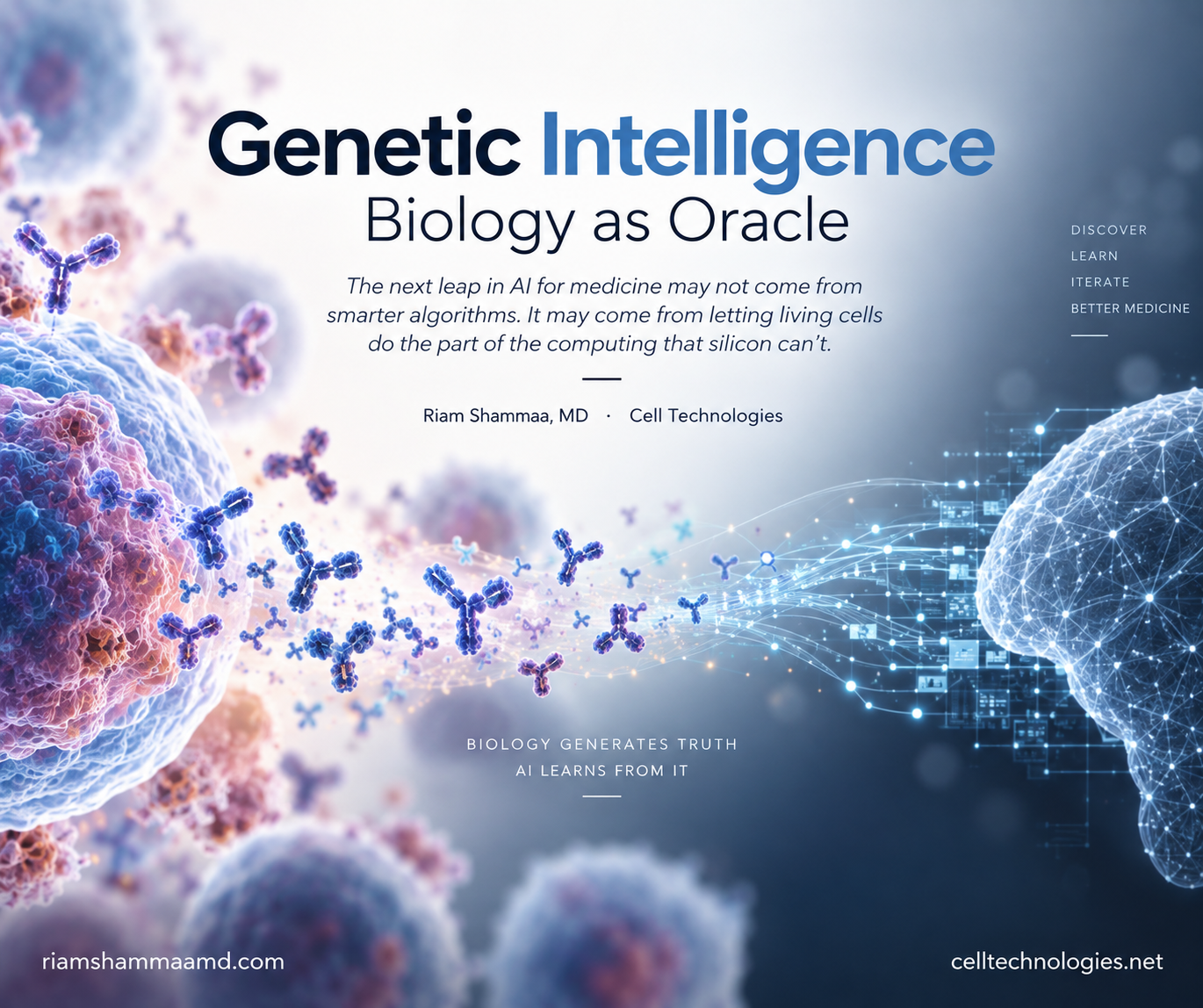
The next leap in AI for medicine may not come from smarter algorithms. It may come from letting living cells do the part of the computing that silicon can’t.
Riam Shammaa, MD · Cell Technologies
Start with a real problem
Suppose you want to design a new antibody drug — a protein that grabs onto a specific molecule on the surface of a cancer cell and flags it for the immune system to destroy. This is one of the most valuable things in medicine, and one of the hardest.
Here’s why it’s hard. A protein is a chain of small building blocks called amino acids, and there are twenty kinds. The order of those blocks decides how the chain folds into a 3-D shape, and the shape decides what it can grab. Change a few blocks and you get a different “variant” with a different shape. The trouble is the sheer number of possibilities: even a modest protein has more possible variants than there are atoms in the observable universe. You cannot try them all, and — this is the key point — you cannot reliably calculate, from the sequence alone, which one will fold correctly and stick to your target. The underlying physics is simply too complex to simulate at that scale.
So how does anyone ever find a good antibody? Not by calculating. By building. You make a library of millions of variants, pour them over the target molecule, and physically pull out the ones that stick. You didn’t compute the answer — you let the molecules sort themselves out in a test tube and read off the result. Each “it stuck” or “it didn’t” is an answer to a question that no computer could have answered for you.
Now add the move that changes everything: record millions of those answers, and train an AI on them. The AI learns the hidden pattern of what makes a binder, and starts predicting results for variants you never even made. The living system was the teacher. The AI is the student that generalizes from its lessons.
That is the whole idea in one sentence: when you can’t compute the answer, let biology produce it — then teach a machine from what biology produced.
I call a living system used this way an oracle. The rest of this paper is about why this is a bigger idea than it first appears, and where it could take medicine.
The thing we’re short of isn’t intelligence. It’s examples.
It’s tempting to think AI progress in biology comes from cleverer models. Mostly it doesn’t. It comes from data — specifically, from large collections of examples that pair a biological “input” with its real “output.” In the antibody story, the input is a protein sequence and the output is “does it stick.” Collect enough of those pairs and even a fairly ordinary model becomes powerful. Without them, the fanciest model has nothing to learn from.
Once you see it that way, the bottleneck moves. The scarce, precious resource isn’t the algorithm — it’s a reliable way to generate honest examples of biology actually doing something. And we are surrounded by machines that produce exactly those examples, all day, for free. We just don’t usually call them machines. We call them cells.
Cells don’t predict outcomes. They produce them.
Picture two ways to answer “will this protein fold into the right shape?” One is to run a simulation on a supercomputer that models every atom and force — slow, expensive, and often wrong. The other is to let a cell build the actual protein, which folds (or misfolds) in a fraction of a second, for almost nothing. The cell isn’t modelling the process. It is the process.
There’s a beautiful reason cells are so good at this. In the computer on your desk, the memory and the processor are separate chips, and a lot of the work is just shuttling data back and forth between them. In a cell, the molecule that stores the information — DNA — is read and executed right where it sits. Storage and computation are the same thing, in the same place. The genome is both the hard drive and the program, and the cell is the machine running it.
And there’s a deeper reason still. Evolution has been running the largest optimization experiment in history for nearly four billion years. The proteins and cells we can study today are its saved results — solutions to problems we don’t know how to solve yet. To use a cell as an oracle is, in a real sense, to read out answers that nature already worked out the hard way.
What “biology as oracle” means in practice
An oracle, here, is any living system you can ask a question and that answers by doing rather than by calculating. You give it inputs you control. It gives back outputs you can measure. You write down the input–output pairs and train a model on them. You don’t need to understand how the cell computes the answer — only that its answers are real and you can collect a lot of them.
It’s worth being honest that this isn’t worth doing for everything. A living system earns the “oracle” label only when a handful of conditions line up:
• It answers a question we genuinely care about and currently predict badly — like “will this drug work on this cell?”
• It produces that answer more cheaply or accurately than a simulation could, because it runs the experiment rather than modelling it.
• You can feed it many different inputs on purpose — millions of protein variants, hundreds of drug combinations, a panel of conditions.
• You can read its answers at scale, usually by tagging the outcome so a sequencing machine or a microscope can count it.
• It gives consistent answers — the same input lands on roughly the same output — so there’s a real pattern to learn.
And here’s the part that excites me most: the payoff is biggest for the messiest questions. When an outcome depends on context — the cell’s state, its environment, its history — simple rules fail and simulations choke. But the living cell handles all of that context automatically, because it’s living it. The harder the question is to compute, the more valuable the oracle becomes.
This already works — and one version won a Nobel Prize
None of this is hypothetical. The antibody example I opened with is, in essence, how real antibody drugs are discovered. And the loop — make variants, let biology pick the winners, learn from the result, repeat — has a name: directed evolution. Frances Arnold won the 2018 Nobel Prize in Chemistry for developing it. She didn’t compute better enzymes; she let biology evolve them, generation after generation, steering the process toward what she wanted.
Today, labs wrap AI around that loop: a model looks at which variants did well, predicts which untried ones might do better, and tells the experiment what to make next. Elsewhere, automated “robot scientists” have gone a step further — forming their own hypotheses, running their own experiments overnight, and learning from the results without a human touching a pipette.
What’s been missing is the unifying view: recognizing that all of these are the same move — use the living system to generate truth, then distill that truth into a model — and then asking where else it could work. The answer is: almost certainly far more places than we currently use it.
The bet I’d stake the whole idea on
If I had to reduce this to one claim that could be proven or demolished, it’s this: for biological questions where context really matters, a model trained on what a living cell actually does will beat a model that’s only shown the “ingredients list” of the input.
In the antibody case, the “ingredients list” is the protein’s sequence. My bet is that the cell knows things the sequence alone doesn’t — because the cell factors in folding quirks, its own state, and its environment that the bare sequence never reveals — and that this extra knowledge is learnable by an AI, if you let the cell be the teacher. If someone shows that the plain ingredients list predicts just as well, the idea fails. I find that clarifying: a good idea should tell you exactly how to find out whether it’s wrong.
Where this goes
Now close the loop. An AI proposes the next batch of things to try; the living cells test them in reality; the AI learns from the results and proposes a smarter next batch; and round it goes — each cycle spending lab effort exactly where it will teach the most. That’s not just automation. It’s a discovery engine, and it doesn’t require us to understand the biology first. It only requires a living system that computes something valuable, and the means to run it at scale.
My larger conviction is simple: a great deal of the biology we currently try — and fail — to predict from first principles could instead be learned directly, by asking the systems that already hold the answer. Nature has been computing for four billion years. We’re only now building the tools to read its results at scale and teach them to a machine. To me, that’s the most exciting frontier where biology and AI meet — and it’s closer than most people think.